 EMZETT.
Internet
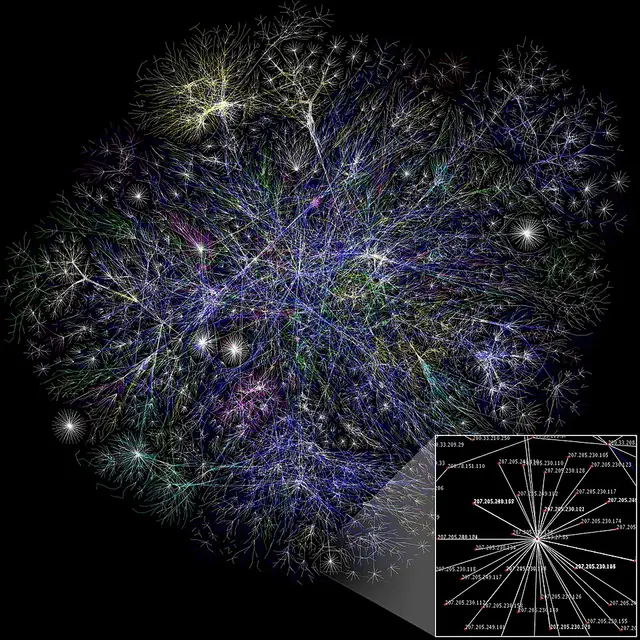 Image: The Opte Project, CC BY 2.5, Wikimedia Commons

In short: The worldwide combination of countless individual networks into one global network, communicating via standardised protocols (especially TCP/IP).
In more detail: Not a centrally managed network, but a “network of networks” (internetworking) — internet service providers, data centres, corporate networks, etc. are connected to each other via routers and backbone lines. Addressing happens via IP addresses, names via DNS.
In Depth
The term “internet” (from “interconnected networks”) describes exactly this principle: not a single large network, but many individual, independently operated networks that connect to each other via standardised protocols. Important building blocks of this structure:
- Backbone networks: extremely high-performance long-distance connections (often fibre optic) connecting large regions/continents, operated by large network operators.
- Internet Exchange Points (IXPs): places where many different networks can exchange their traffic directly with each other, instead of via detours.
- Autonomous systems: every larger network (a provider, a university network, a large company) manages its own address range independently and exchanges routing information with other autonomous systems via the BGP protocol.
No company and no government “owns” the internet as a whole — it works because all participating networks voluntarily stick to the same open standards (TCP/IP, DNS, HTTP, etc.), developed and maintained by organisations like the IETF, but owned by no one.